What Is Mecha? The Giant Robot Genre Explained
Mecha is the manga/anime genre built around piloted giant robots. Learn its meaning, subtypes, tropes, and how to build your own mecha story.
Written by Bugra, founder of Gootaku
Quick answer
Mecha is a genre of manga and anime centered on giant, piloted robots, usually operated by a human crew from an internal cockpit for war, sport or exploration. The drama comes from a small, vulnerable pilot controlling an enormous machine, as in Gundam and Evangelion.
Contents
Mecha is a genre of manga and anime centered on giant, piloted robots — usually operated by a human crew from an internal cockpit — used for war, sport, or exploration, where the drama comes from a small, vulnerable pilot controlling an enormous, powerful machine.
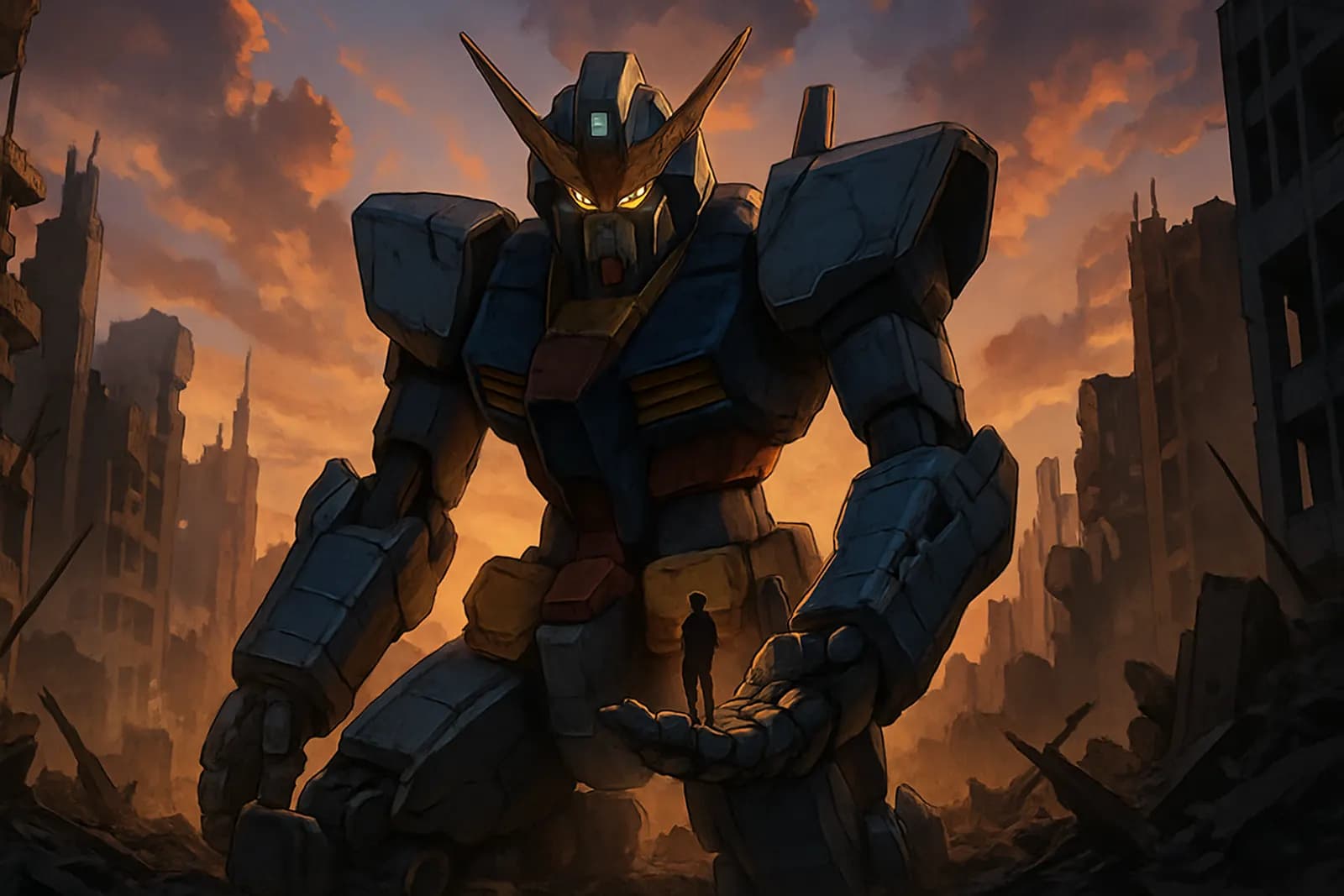
If you've watched Mobile Suit Gundam, Neon Genesis Evangelion, Code Geass, or Tengen Toppa Gurren Lagann, you've seen mecha in action. It's one of the oldest and most influential genres in anime and manga history, responsible for some of the medium's most iconic imagery: a human silhouette dwarfed by a machine the size of a building, a cockpit lit up with control panels, a robot's fist crashing through a skyline.
Key facts
- Japanese: メカ (meka), short for loanwords from "mechanical" / "mechanism".
- Super robot root: Mazinger Z by Go Nagai (1972) popularized the piloted giant robot.
- Real robot root: Mobile Suit Gundam (1979) recast mecha as mass-produced military hardware.
- Psychological turn: Neon Genesis Evangelion (1995) made the pilot's mind the center of the genre.
- Still active: Gundam: The Witch from Mercury (2022) and Mobile Suit Gundam GQuuuuuuX (2025) keep the franchise in new hands.
---
What "Mecha" Literally Means
Mecha is written メカ in Japanese, a shortened form of mekanikaru (メカニカル) or mekanizumu (メカニズム) — loanwords borrowed from the English words "mechanical" and "mechanism." In Japanese, "mecha" originally just meant "machine" or "mechanical thing" in a broad sense, the same way an English speaker might casually say "the mech" to mean any robotic hardware.
Over time, as giant-robot stories became a dominant anime and manga category from the 1970s onward, "mecha" narrowed from a generic word for machinery into a specific genre label — shorthand for stories about large robotic vehicles, almost always with a human pilot inside.
So when fans say a series "is mecha," they don't just mean it has robots in it somewhere. They mean the giant, piloted machine is central to the plot, the conflict, and the visual identity of the show.
---
The Core Premise
Nearly every mecha story shares the same basic skeleton:
- A human pilot — often young, sometimes reluctant, thrust into the cockpit of a machine far more powerful than they are prepared for.
- A giant robot — a mechanical body, ranging from a few meters to hundreds of meters tall, that the pilot controls from inside, usually through some kind of neural, physical, or synchronized interface.
- A scale mismatch — the machine is enormous and destructive; the person inside it is fragile and human. That gap is the emotional engine of the genre.
- A conflict that requires the machine — war, invasion, a tournament, an apocalyptic threat — something that can only be resolved by piloting the mecha, not by ordinary human means.
---
Common Mecha Subtypes
Mecha stories tend to fall into a few recognizable design and tone camps. These aren't strict boxes — plenty of series blend them — but they're the vocabulary fans use to talk about the genre.
Super Robot
The earlier, more mythic strain of mecha, associated with shows like Mazinger Z and carried forward stylistically by later series such as Tengen Toppa Gurren Lagann. Super robot stories treat the machine as something closer to a magical or heroic artifact than a piece of engineering — one robot, built or gifted for a singular purpose, capable of escalating power-ups, dramatic transformations, and finishing moves. Physics and resource logistics take a back seat to spectacle, willpower, and triumphant, larger-than-life combat.Real Robot
The grounded counterpart, most closely associated with the Mobile Suit Gundam franchise. Real robot stories treat mecha as military hardware: mass-produced units, fuel and ammunition limits, chains of command, and battles where numbers, tactics, and terrain matter as much as any single pilot's skill. The tone leans toward war drama — machines get damaged, pilots die, and politics shapes the battlefield as much as combat does. This subtype is where mecha most overlaps with grounded science fiction.Evangelion-style Psychological/Biomechanical
A hybrid strain, defined largely by Neon Genesis Evangelion, that blurs the line between machine and organism. The "robot" may have flesh-like or biological qualities beneath its armor, the pilot's mental state directly affects how the machine performs, and the story leans into psychological tension, trauma, and existential dread alongside the combat. These stories use the giant-robot framework to externalize a character's inner state — the cockpit becomes almost a therapy chamber as much as a weapons platform.Beyond these three, you'll also see mecha blended with other genres — transforming jet-fighter mecha in the Macross-style tradition, rebellion and mind-games political thrillers like Code Geass, and cyberpunk-flavored mecha where the machines are as much corporate assets as war machines. But super robot, real robot, and the Evangelion-style psychological hybrid are the three reference points most fans and creators use to place a new series.
---
Why Mecha Resonates
Mecha has stayed a core anime and manga genre for decades because it hits several appeals at once.
Scale as spectacle. There's a visceral thrill to watching something enormous move — a robot's footstep cracking pavement, a beam weapon vaporizing a city block. Mecha gives artists and animators a canvas for pure scale that human-sized action can't match.
Vulnerability inside power. The pilot is almost always breakable in a way the machine isn't. That contrast — a fragile person wrapped in armor that can level buildings — creates built-in tension. Every fight carries the question of whether the person survives, not just whether the robot does.
Coming-of-age through war. Many of the genre's defining stories put teenagers in the cockpit, turning the mecha into a literal vehicle for growing up under pressure. Piloting the machine becomes inseparable from confronting loss, responsibility, and the cost of violence — themes that hit harder because the stakes are dressed in giant-robot spectacle rather than a quiet drama.
Machine design as its own art form. Mecha fandom has a genuine love of industrial design — silhouettes, joint mechanics, weapon load-outs, transformation sequences. A well-designed mecha is collectible and iconic the way a great character design is, and franchises build entire toy and model-kit industries around getting that design right.
---
Mecha vs Regular Sci-Fi/Action
Every mecha story is science fiction (or at least science-fantasy), but not every sci-fi or action story is mecha, and the distinction trips people up.
The defining line is the piloted machine as the locus of conflict and identity. A story can be full of futuristic technology, space travel, and robots without being mecha — if the machines are background tech, autonomous AI, or small-scale gadgets rather than a giant, human-piloted body that the story treats as an extension of its protagonist, it isn't mecha in the genre sense.
| | Regular Sci-Fi/Action | Mecha | |---|---|---| | Central conflict | Resolved through characters, tech, or strategy generally | Resolved specifically through piloting a giant machine | | Robots | May be autonomous, background, or minor | Central, piloted, human-scale drama inside machine-scale power | | Protagonist's power | Skill, weapons, abilities | The machine itself, which the pilot must learn to carry | | Iconic imagery | Varies by story | Cockpit interiors, scale shots, transformation, silhouette | | Emotional core | Varies widely | Vulnerability of the human inside an overwhelming machine |
Remove the giant piloted machine and the human-scale drama trapped inside it, and you're left with generic science fiction. Keep it, and you have mecha.
---
How to Build Your Own Mecha Story
Mecha rewards clear design choices early — a robot with vague rules and no visual identity won't carry a story. A simple way to start:
- Pick your subtype. Super robot power-fantasy, real robot war drama, or Evangelion-style psychological hybrid? This decides your tone, pacing, and how "realistic" the machine's limits should feel.
- Define the machine's rules and limits. Fuel, ammunition, sync rate with the pilot, cooldowns, damage that persists between fights — decide what the mecha can't do. Limits are what make victories feel earned.
- Give the pilot a stake beyond winning. A reason they're in the cockpit that isn't just duty — grief, guilt, a person they're protecting, a debt they owe. The machine should cost the pilot something.
- Design a silhouette-readable mech. Your robot should be recognizable from a distance, in shadow, in a single panel — a distinct head shape, color scheme, or weapon silhouette. Readers should know which mech is which without a label.
- Set the tone up front. Triumphant power fantasy, grounded military drama, or psychological unease — pick one so your art direction, dialogue, and pacing all point the same way.
For the visual side — mechanical detail, scale composition, prompt templates for specific mecha styles, and how to keep a mech design consistent across panels — read our Mecha Manga Style Guide.
Start designing mechs on Gootaku → — 1 free token to start and 1 more every 2 days, no card required.
---
Keep Reading
- Mecha Manga Style Guide — Visual codes and prompt templates for giant robots
- What Is Isekai? — The other-world genre, a different flavor of fantasy escapism
- What Is Shonen? — The demographic mecha frequently overlaps with
- What Is Gootaku? — The AI tool where you write and the AI draws
More ways to bring this to life
FAQ
What does mecha mean in English? Mecha (メカ) is a shortened Japanese loanword from "mechanical" or "mechanism." As a genre label, it refers to stories built around giant, human-piloted robots, rather than machinery in general.
Is mecha a genre or just a robot design style? It's a genre. While "mecha" can describe a robot's visual design, in manga and anime it names a full storytelling category defined by a human pilot controlling a giant machine, with the pilot-machine relationship as the emotional core of the story.
What's the difference between super robot and real robot mecha? Super robot stories treat the mecha as a near-mythic, singular hero machine with escalating power-ups and heroic spectacle, largely unconcerned with realistic limits. Real robot stories treat mecha as military hardware — mass-produced, fuel- and ammo-limited, and shaped by tactics and chain of command, closer to war drama.
What makes Evangelion-style mecha different? Evangelion-style mecha blend biological and mechanical qualities, tying the pilot's psychological state directly to how the machine performs. These stories use the giant-robot format to dramatize inner trauma and existential themes alongside combat, rather than focusing purely on tactics or power fantasy.
Do I need to be able to draw to make a mecha manga? No. With an AI manga tool like Gootaku, you write the story and the AI generates the art. You describe the pilot, the machine, and the scene — a cockpit interior, a scale-establishing shot, a beam weapon firing — and produce manga panels without drawing them yourself.
Ready to create your own manga?
Start free — no credit card required. 1 free AI generation on signup, +1 every 2 days.
Start CreatingOn the go? Get the Gootaku iPhone app.
Related guides
Mecha Manga Style Guide — AI Art Prompts for Giant Robots
Master the mecha manga aesthetic for AI — mechanical design, action composition, sci-fi backgrounds,…
What Is a Screentone? Manga Shading Explained
Screentones are the dotted shading patterns that give B&W manga its look. Here's what they are, how …
What Is Seinen? Meaning, Themes & Examples
Seinen (青年) means “young man”: manga for adult readers, darker and more complex than shonen. What se…
What Is Shojo? Bigger Than "Romance for Girls
Shojo (少女) means “young girl”: manga for teen girls, focused on emotion and relationships, not only …
Fantasy Manga Style Guide — AI Art Prompts for Epic Worlds
Master the fantasy manga style for AI — ornate armor, magic auras, sweeping castles, and copy-paste …
Historical Manga Style — Visual Guide for AI Creators
Master the look of historical manga — period costume, era-correct detail, brushwork and texture. Cop…