What Is Shonen? Definition, Examples & Origins
Shonen (少年) means “young boy”: manga for teen boys, built on action, rivalry and growth. The shonen definition, origins and defining series.
Written by Bugra, founder of Gootaku
Quick answer
Shonen means Japanese manga and anime aimed primarily at boys aged 12 to 18, defined by friendship, perseverance, action and self-improvement. It includes most globally famous series, such as One Piece, Naruto and Demon Slayer, and its real audience is far broader than its target.
Contents
Quick Answer
Shonen (少年, pronounced show-nen, "boy") means Japanese manga and anime targeted primarily at boys ages 12-18. It's defined by themes of friendship, perseverance, action, and self-improvement — and includes most globally famous manga: One Piece, Naruto, Demon Slayer, My Hero Academia, Jujutsu Kaisen, and Dragon Ball.
Despite being marketed at teen boys, shonen's audience is massively broader. Adult women and men globally read shonen at scale. The "target demographic" is publishing-side; the actual audience is anyone who enjoys action stories with character growth.
Key facts
- Japanese: 少年, shō (few, young) + nen (year, age): "boy." Also romanized shounen or shōnen.
- Type: a demographic (publishing label), not a genre. Shonen includes action, sports, comedy, romance and horror.
- Flagship magazine: Weekly Shōnen Jump (Shueisha), launched in 1968; rivals include Weekly Shōnen Magazine and Weekly Shōnen Sunday, both from 1959.
- Best-selling series: One Piece (since 1997) has sold more than 500 million copies worldwide.
- Generational turnover: My Hero Academia ended in August 2024 and Jujutsu Kaisen in September 2024, while Dandadan, Kagurabachi and Sakamoto Days rose as the next wave.
What "Shonen" Literally Means
The kanji breaks down as:
- 少 (sho/few/young)
- 年 (nen/year)
In Japan, "shonen" is a publishing demographic label. A magazine like Weekly Shonen Jump (which publishes One Piece, Jujutsu Kaisen, etc.) is by definition shonen because of its target reader, not because of any visual or thematic rule. Younger readers usually come to shonen from kodomo manga, the demographic made for children.
What Makes a Series Shonen?
While the publishing definition is "marketed to young boys," the genre has accumulated reliable conventions:
Common shonen themes
- Friendship (often the central theme)
- Self-improvement and training
- Overcoming impossible odds
- Discovery of one's true potential or power
- Standing up for the weak
- Found family / chosen family
- The journey itself (often more than the destination)
Common shonen visual codes
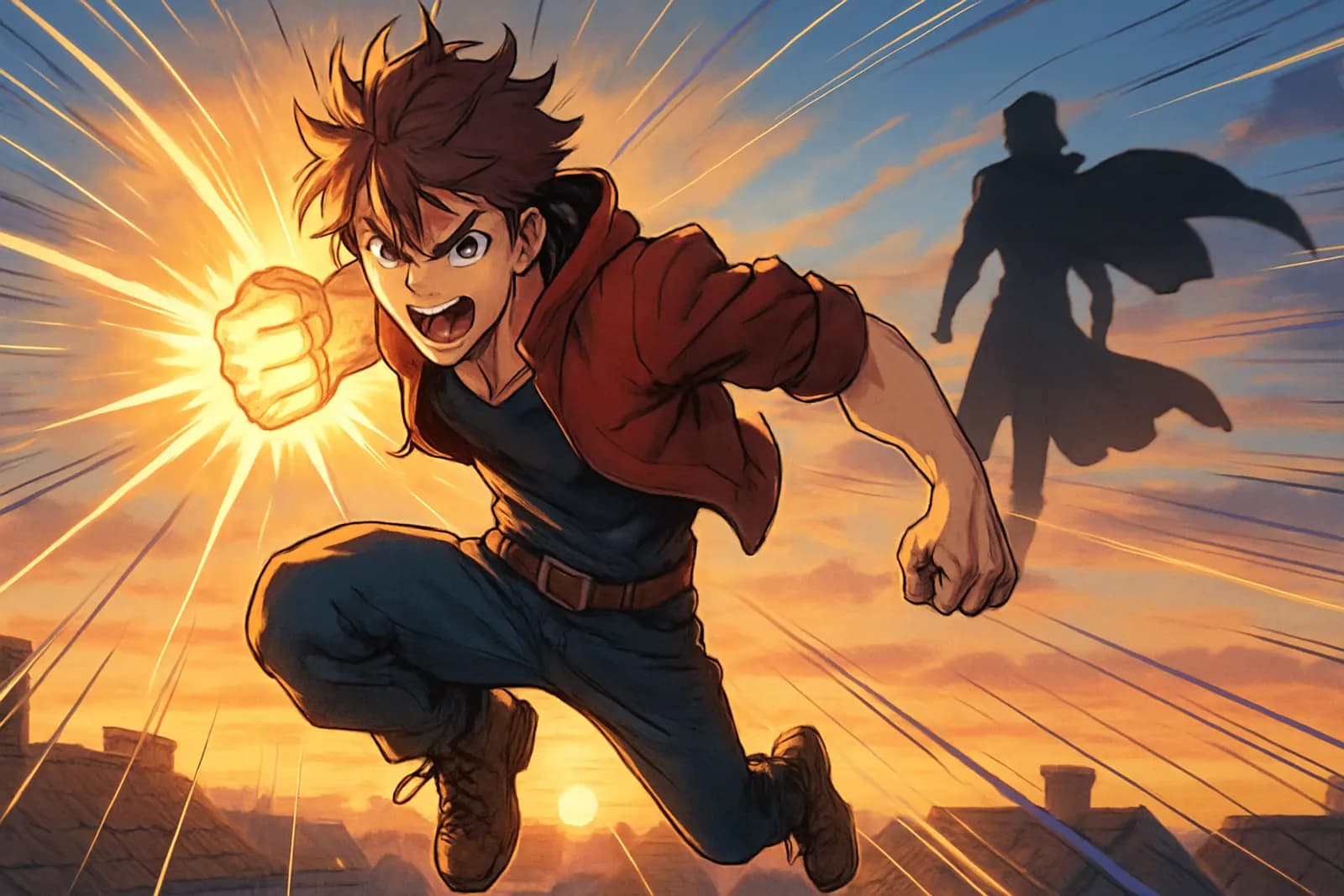
- Dynamic action sequences with motion lines and impact bursts
- Bold, expressive character designs with memorable silhouettes
- Dramatic camera angles (low-angle hero shots, splash pages)
- Heavy use of Japanese SFX (DON!, ZUDOOON!, etc.)
- High-contrast inking with hard shadows
Common shonen plot structures
- The hero starts weak, becomes strong through training arcs
- A central villain or threat drives the story
- Episodic battles escalate in stakes
- Each arc resolves while opening a bigger arc (the "power creep" pattern)
The Biggest Shonen Series Ever
By global influence and sales:
- One Piece (1997-present) — Eiichiro Oda. 500+ million copies sold. Pirates, adventure, friendship.
- Dragon Ball (1984-1995) — Akira Toriyama. The blueprint for modern battle shonen.
- Naruto (1999-2014) — Masashi Kishimoto. Ninja village, friendship, redemption.
- Demon Slayer (2016-2020) — Koyoharu Gotouge. Period horror-shonen, family.
- My Hero Academia (2014-2024) — Kohei Horikoshi. Superhero school, Western-influenced shonen.
- Jujutsu Kaisen (2018-2024) — Gege Akutami. Modern dark shonen, curses and exorcists.
- Attack on Titan (2009-2021) — Hajime Isayama. Technically shonen but seinen in tone.
- Hunter × Hunter (1998-present, on hiatus) — Yoshihiro Togashi. Deep worldbuilding, complex power systems.
- Bleach (2001-2016) — Tite Kubo. Soul reapers, cool aesthetics, long arcs.
- Fullmetal Alchemist (2001-2010) — Hiromu Arakawa. Tightly plotted, philosophical.
The new wave (2023–2025)
- Dandadan — Yukinobu Tatsu. Aliens, ghosts and a chaotic teen romance; the anime began in October 2024.
- Kaiju No. 8 — Naoya Matsumoto. A middle-aged man who can turn into a kaiju joins the defense force; anime from April 2024.
- Sakamoto Days — Yuto Suzuki. A retired legendary hitman running a convenience store; anime from January 2025.
- Kagurabachi — Takeru Hokazono. A swordsmith's son on a revenge quest, serialized in Weekly Shōnen Jump since 2023.
- Blue Box — Kouji Miura. A sports-and-romance series with an anime from October 2024, proof that shonen is not only battles.
Shonen vs Other Manga Demographics
| Demographic | Target | Examples | Common themes | |-------------|--------|----------|---------------| | Shonen | Boys 12-18 | One Piece, Naruto, MHA | Friendship, action, growth | | Shojo | Girls 12-18 | Sailor Moon, Fruits Basket | Romance, emotion, identity | | Seinen | Men 18-40 | Berserk, Vagabond, Monster | Maturity, complexity, gravity | | Josei | Women 18-40 | Nana, Honey and Clover | Adult relationships, careers | | Kodomomuke | Children <12 | Doraemon, Pokémon | Light, educational, comedy |
These are publishing labels, not strict creative categories. Many series technically labeled shonen read like seinen (Attack on Titan). Many josei magazines run series with shonen-style action.
Why Shonen Dominates Globally
Several reasons:
1. The themes are universal
Friendship, perseverance, becoming your best self — these resonate at any age in any culture. You don't have to be a Japanese teenage boy to feel Luffy's loyalty or Naruto's determination.2. Shonen Jump's distribution machine
Weekly Shonen Jump is the world's biggest manga magazine. Its model — serialized chapters, fan voting, weekly cliffhangers — has produced more global hits than any other publishing entity.3. Adaptable to anime
Shonen's visual style and pacing translate cleanly to anime. Most anime hits are shonen adaptations.4. Merchandising
Shonen characters (memorable silhouettes, distinctive abilities) merchandise well — figures, games, apparel, theme parks.5. Scaling stakes
The escalation pattern — small fight → bigger fight → world-ending fight — gives shonen massive narrative runway. One Piece has run for 27+ years without losing momentum.Sub-Genres of Shonen
Shonen has internal variety:
- Battle shonen (Dragon Ball, Naruto, Bleach) — power-based fights, training arcs
- Sports shonen (Haikyuu!!, Slam Dunk, Kuroko's Basketball) — team competition
- Romantic comedy shonen (Kaguya-sama, Nisekoi) — romance with comedic frame
- Dark fantasy shonen (Chainsaw Man, Jujutsu Kaisen) — mature themes within shonen format
- Slice-of-life shonen (Spy × Family, Daily Lives of High School Boys) — comedy + heart
- Isekai shonen (Sword Art Online, That Time I Got Reincarnated) — fantasy world travel
Is Shonen Just For Boys?
No. This is a publishing label, not an audience reality.
Recent data shows roughly 40-50% of manga readers globally are women, and many gravitate to shonen. Series like Demon Slayer, Jujutsu Kaisen, and Chainsaw Man have massive female fan bases.
The label persists because Japanese publishing organizes its magazines by demographic. But the actual reading audience is much broader. A 40-year-old woman in São Paulo can absolutely be a One Piece superfan — and many are.
Shonen vs Shojo: The Quick Distinction
The most common comparison:
| | Shonen | Shojo | |---|--------|-------| | Target | Boys 12-18 | Girls 12-18 | | Plot focus | External conflict (fights, adventures) | Internal conflict (relationships, emotions) | | Pacing | Faster, action-driven | Slower, emotional | | Art style | Bold, dynamic, hard shadows | Soft, ornate, sparkly | | Romance | Usually subplot | Usually main plot | | Common ending | Hero defeats final boss | Romantic resolution |
For visual deep-dive: shonen style guide vs shojo style guide.
How to Create Your Own Shonen Manga
If you're inspired to make shonen, focus on:
- A protagonist with a clear dream (Luffy: become Pirate King; Naruto: become Hokage)
- A central villain or threat that escalates over time
- A "found family" cast that grows with the hero
- Training / power-up arcs between major battles
- Cliffhangers at the end of every chapter
- Visual identity with bold, memorable character designs
The Future of Shonen
As of 2026, shonen continues to evolve:
- Female protagonists in shonen (Nausicaä was decades ago; now common)
- Darker / more adult shonen crossing into seinen territory
- Webtoon shonen (Korean creators applying shonen formulas to vertical scroll)
- AI-assisted shonen (Gootaku is one of multiple tools enabling new creators)
Quick Facts
- First major shonen magazine: Shonen Club (1914), but modern shonen begins with Shonen Jump (1968)
- Most-sold shonen ever: One Piece (500+ million copies)
- Best-selling single shonen volume: Demon Slayer Vol. 23 (over 4 million copies in Japan alone)
- Total shonen market (Japan + global, 2024 est): $12+ billion in physical + digital + merchandise
Try Making Shonen
If reading about shonen made you want to make some, the barrier has never been lower:
- Write a 1-page chapter outline (premise, hero, villain, conflict)
- Use Gootaku Studio with shonen style
- Generate panels, add dialogue and SFX
- Publish to Gootaku's community feed or cross-post to Webtoon Canvas
The Gootaku Manga Maker ships a dedicated Shōnen style preset tuned for exactly this — dynamic action poses, speed-line screentone, and dramatic panel composition — so your outline turns into shonen-look art without any prompt-tuning.
Try the AI Manga Maker → — 1 free token to start and 1 more every 2 days, no card required.
---
More ways to bring this to life
Frequently Asked Questions
What is the definition of shonen?
Shonen (少年) is a Japanese publishing category aimed at boys roughly ages 12-18, defined by themes of friendship, perseverance, and action. It's a demographic label, not a strict genre — it describes who a manga magazine is marketed to, not a fixed set of story rules.
What does shonen mean literally?
Shonen literally translates to "young boy" or "youth" from the kanji 少 (few/young) and 年 (year). In practice, it's used as shorthand for the entire category of boys' action manga, including hits like One Piece, Naruto, and My Hero Academia.
Is shonen only for boys?
No. While shonen is marketed to teen boys in Japan, its actual global readership is close to evenly split, with a large share of adult women and men reading and loving shonen series. The label is a publishing convention, not a rule about who's allowed to enjoy it.
What's the difference between shonen and seinen?
Shonen targets teen boys with themes of friendship and growth, while seinen targets adult men (18-40) with more mature, complex, and often darker storytelling. Many shonen fans "graduate" to seinen as both they and the stories they read grow up.
Related Definitions
- What is Webtoon? — The Korean vertical-scroll comic format
- What is Manga vs Anime? — The two are different things
- What is Screentone? — The dot pattern shading manga uses
Deeper Guides
- Shonen Manga Style Guide — Visual codes in detail
- Shojo Manga Style Guide — Shonen's sister genre
- Seinen Manga Style Guide — Where shonen graduates to
- Josei Manga Style Guide — The adult women's counterpart to shojo
- Sports Manga Style Guide — Athletic competitions often blend shonen energy
- Mecha Manga Style Guide — Giant robots in shonen narrative
- How to Create AI Manga in 2026 — Make your own
Ready to create your own manga?
Start free — no credit card required. 1 free AI generation on signup, +1 every 2 days.
Start CreatingOn the go? Get the Gootaku iPhone app.
Related guides
Shonen Manga Style — Complete Guide for AI Creators
Learn the visual codes of shonen manga — dynamic action lines, dramatic shadows, screentones, bold i…
What Is Slice of Life? The Everyday-Moments Genre Explained
Slice of life is the manga/anime genre built around ordinary, everyday moments instead of dramatic p…
What Is Supernatural Manga? The Hidden-World Genre Explained
Supernatural manga puts spirits, curses, and psychic powers inside our own world. Learn its meaning,…
What Is Yuri? Meaning, and How It's Different From Shojo-ai
Yuri (百合, “lily”) is the genre about romance between women in manga and anime. What yuri means, how …
Retro Comic Style — Complete Guide for AI Creators
Master the retro 80s-90s comic style — halftone color, bold Silver Age ink, huge lettered SFX. Compo…
Romance Manga Style — Visual Guide for AI Creators
Master the look of romance manga — expressive eyes, soft glow, flower motifs, intimate framing. Copy…