Japanese Manga Sound Effects — Complete Onomatopoeia Guide
The definitive guide to manga SFX — 100+ Japanese onomatopoeia with romanizations and meanings, plus how to add them to AI-generated panels.
Written by Bugra, founder of Gootaku
Quick answer
Manga sound effects are Japanese onomatopoeia drawn into the art, words like doki doki for a pounding heart or shiin for silence. They fall into giseigo (sound words) and gitaigo (state words), let readers hear and feel a panel, and can be added to AI-generated panels.
Contents
Manga sound effects (SFX) are Japanese onomatopoeia drawn into the art, words like ドキドキ (doki doki, a pounding heart) or シーン (shiin, silence) that let readers hear sounds and feel moods on the page. Open any Japanese manga and you'll see them everywhere: stylized characters splashed across panels — ドドド, ドキドキ, シーン. These are giseigo (擬声語, sound words) and gitaigo (擬態語, state words), and they do something Western comics rarely do: they make readers hear and feel the panel.
If you're creating manga with AI, your generated images are silent until you add SFX. This guide is the reference you keep open.
Key facts
- Two families: giseigo (擬声語) imitate real sounds; gitaigo (擬態語) describe states, feelings and motions that make no sound, such as kira kira (sparkle) or shiin (silence).
- Script: most manga SFX are written in katakana for punch; hiragana is used for softer, rounder effects.
- Density: a typical 20-page chapter carries dozens of SFX, often 40 to 80.
- Translation: modern English editions usually keep the Japanese art and add a small English or romaji subtitle, rather than redrawing it.
- Most recognizable: ゴゴゴゴ (gogogo, menace) became a global meme through JoJo's Bizarre Adventure.
Why SFX Matter in Manga
In a typical 20-page manga chapter, you'll find 40-80 SFX overlays. They're not decoration — they carry information:
- Sound: Footstep, sword swing, door slam
- State of being: Silence, tension, the feeling of staring
- Emotion: Heartbeat, blush, shock
- Motion: Speed, rushing, slowness
The art shows; SFX tells you how to read the silence.
Two Categories: Giseigo vs Gitaigo
Giseigo (擬声語) — Actual sounds
Onomatopoeia that mimics real sound:- ドン (DON) — Heavy impact thud
- バン (BAN) — Sharp bang
- ザー (ZAA) — Pouring rain
Gitaigo (擬態語) — States and feelings
Words that "sound like" a state but make no real sound:- シーン (SHIIN) — Silence (literally the sound of silence)
- キラキラ (KIRA KIRA) — Sparkling
- ドキドキ (DOKI DOKI) — Heart pounding (you can't actually hear it from outside)
The Big List — 50+ Essential Manga SFX
Impact & Combat
| Japanese | Romaji | Meaning | |----------|--------|---------| | ドン | DON | Heavy impact, dramatic entrance | | バン | BAN | Sharp slam, gunshot, door slam | | ドカン | DOKAN | Explosion | | ガシャン | GASHAN | Glass breaking | | ザシュッ | ZASHU | Sword/knife stab | | ヒュン | HYUN | Sharp swing through air | | バキッ | BAKI | Bone crack, hard hit | | ドサッ | DOSA | Body falling heavy | | ボキッ | BOKI | Sharp snap (bone, twig) | | ゴゴゴ | GO GO GO | Rumbling, ominous power building |
Movement
| Japanese | Romaji | Meaning | |----------|--------|---------| | サッ | SA | Quick movement (dodge, grab) | | スッ | SU | Smooth gentle motion | | ザッ | ZA | Footstep, foot landing firmly | | ダッ | DA | Sudden dash, run starting | | シュッ | SHU | Sharp swift movement | | ピョン | PYON | Hop, jump | | ヨロヨロ | YORO YORO | Staggering, wobbling | | トテトテ | TOTE TOTE | Toddling, tiny-step walking |
Heartbeats & Emotion
| Japanese | Romaji | Meaning | |----------|--------|---------| | ドキドキ | DOKI DOKI | Heart pounding (excitement / love) | | ドキッ | DOKI | Single heart-skip (shock) | | ドクン | DOKUN | Heavy heartbeat (dread, dread) | | キュン | KYUN | Heart-squeeze (cute moment, "moe") | | キュンキュン | KYUN KYUN | Repeated heart-squeezes | | ジーン | JIIN | Deeply moved, emotional warmth | | ズキン | ZUKIN | Sharp pain (physical or emotional) |
Sparkle, Shine, Cute
| Japanese | Romaji | Meaning | |----------|--------|---------| | キラキラ | KIRA KIRA | Sparkling (eyes, magic, joy) | | キラッ | KIRA | Single sparkle/glint | | ピカッ | PIKA | Flash of light | | フワフワ | FUWA FUWA | Floaty, fluffy, soft | | モフモフ | MOFU MOFU | Fluffy soft (animal fur) | | ニコッ | NIKO | Smile | | ニヤッ | NIYA | Smirk (mischievous smile) | | ペコッ | PEKO | Polite bow |
Silence & Atmosphere
| Japanese | Romaji | Meaning | |----------|--------|---------| | シーン | SHIIN | Silence (the iconic one) | | しーんとした | SHIIN TO SHITA | Silent state | | ザワザワ | ZAWA ZAWA | Crowd murmur, unease | | ガヤガヤ | GAYA GAYA | Boisterous crowd noise | | ゴウ | GOU | Wind, large presence rushing | | ヒュー | HYUU | Wind whistling | | シトシト | SHITO SHITO | Light rain | | ザー | ZAA | Heavy rain |
Surprise & Shock
| Japanese | Romaji | Meaning | |----------|--------|---------| | ガーン | GAAN | Shock / despair | | ハッ | HA | Sudden realization | | エッ?! | E?! | "Huh?!" (surprise) | | ギクッ | GIKU | Caught / startled | | ゾクッ | ZOKU | Chills down spine | | ゾワッ | ZOWA | Creepy feeling, hair standing |
Eating & Drinking
| Japanese | Romaji | Meaning | |----------|--------|---------| | パクッ | PAKU | Quick bite | | モグモグ | MOGU MOGU | Chewing | | ペロッ | PERO | Lick | | ゴクッ | GOKU | Swallow | | ズルズル | ZURU ZURU | Slurping noodles | | ガツガツ | GATSU GATSU | Eating ravenously |
Sleep & Rest
| Japanese | Romaji | Meaning | |----------|--------|---------| | スヤスヤ | SUYA SUYA | Peaceful sleep breathing | | グーグー | GUU GUU | Snoring | | Zzz | (international) | Sleeping (used universally) | | あくび (yawn) | AKUBI | Yawning sound |
Magic & Energy
| Japanese | Romaji | Meaning | |----------|--------|---------| | ボワッ | BOWA | Magical aura appearing | | メラメラ | MERA MERA | Burning, flame | | ゴゴゴゴ | GO GO GO GO | Building power, ominous | | ピリピリ | PIRI PIRI | Tingling electricity | | パチパチ | PACHI PACHI | Crackling (fire, electricity) |
How to Style SFX in Your Panels
The visual treatment of an SFX is as important as the word itself:
Size = volume
- Tiny text = whispered, distant, subtle
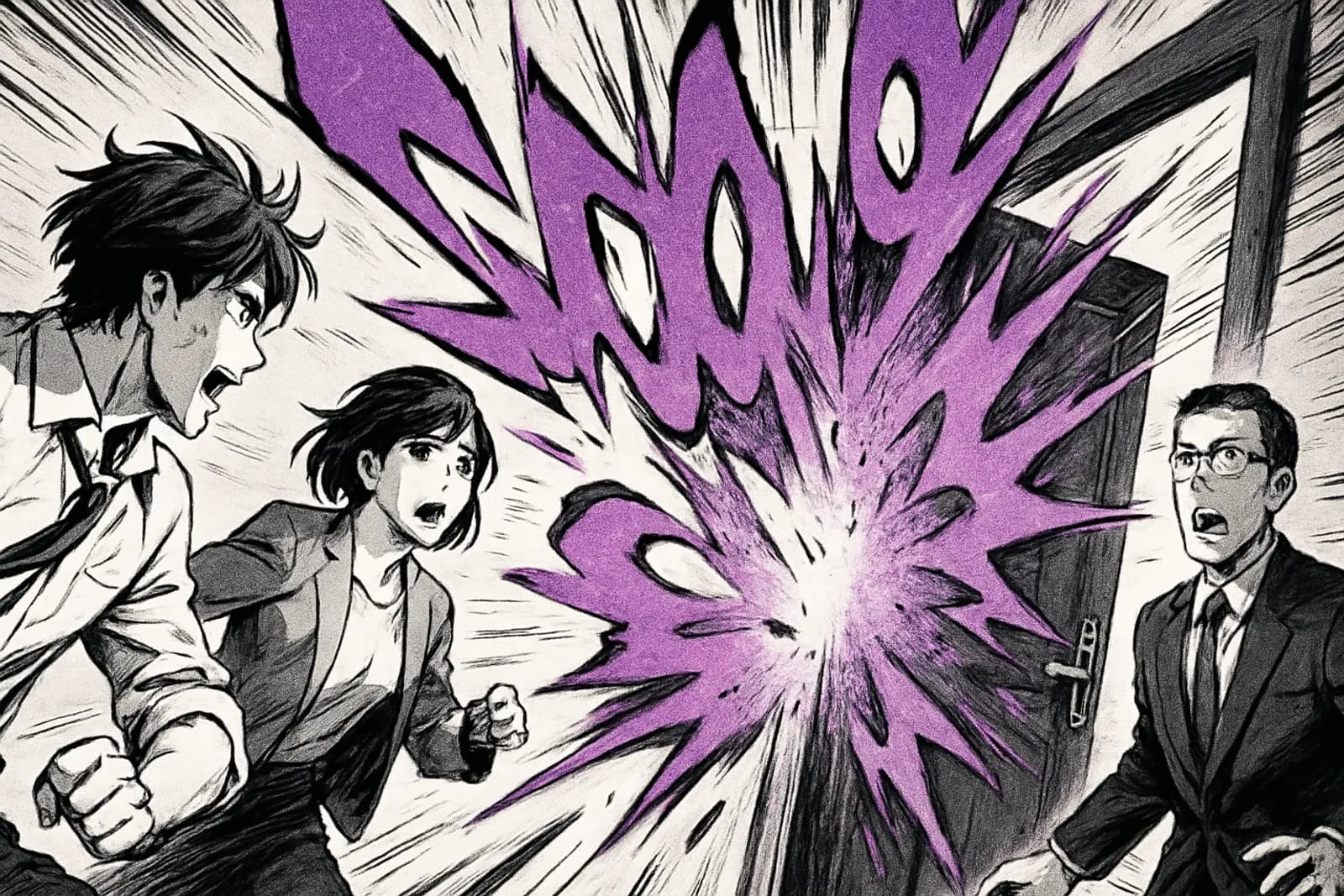
- Page-spanning massive letters = devastating impact
Shape = mood
- Sharp angular characters = aggressive, shocking
- Round bubbly characters = cute, soft
- Dripping / melted characters = goo, blood, slime
- Cracked / broken characters = damage, destruction
Color
- Red = heat, blood, anger
- White outline on dark = nighttime SFX
- Gradient effects for magic / sparkles
- Black ink for traditional manga feel
Placement
- Inside the panel border — Standard, integrated with art
- Breaking the border — Massive impact, draws eye out
- Behind the character — Aura, atmosphere
- Across the gutter — Multi-panel echo (sustained sound)
When to Translate vs Leave Japanese
Three approaches in English-language AI manga:
Approach 1: Keep Japanese only
The traditional "scanlation" style. Reader learns the SFX from context.- Pros: Authentic feel, looks cool
- Cons: New readers confused
Approach 2: Japanese + romaji subtitle
ドキドキ with small "DOKI DOKI" below.- Pros: Authentic + accessible
- Cons: Visual clutter
Approach 3: English equivalent
Replace ドン with "THOOM" or "BOOM" rendered manga-style.- Pros: Clear to Western readers
- Cons: Loses Japanese authenticity, no equivalent for many gitaigo
SFX for AI-Generated Manga
Since AI tools (Gootaku, others) generate images without SFX baked in, you add them in the editor afterward:
Step 1: Generate the panel cleanly
Don't ask the AI to render the SFX text — AI handles text poorly, especially Japanese characters. Generate the image first.Step 2: Add SFX as a separate layer
In Gootaku's Manga Maker, each panel has an SFX field. You can:- Click a preset: ドキドキ DOKI, ザーッ ZAA, バン BAN, シーン SHIIN, ガーン GAAN or キラキラ KIRA
- Type any custom SFX, in Japanese, romaji or both (for example "ゴゴゴ GOGOGO")
Step 3: Match the effect to the moment
Pick SFX that fit the beat: one strong effect per panel reads better than three. For a bigger, hand-placed effect, export the page and letter it in a drawing app.The 12 Essential SFX (If You Only Learn These)
For 80% of manga scenes, these 12 cover you:
- ドキドキ DOKI DOKI — Heart pounding (romance, fear)
- シーン SHIIN — Silence (after a shock or punchline)
- キラキラ KIRA KIRA — Sparkling (joy, magic, beauty)
- ガーン GAAN — Shock / despair (anytime someone learns bad news)
- ドン DON — Heavy impact (entrances, hits, drops)
- バン BAN — Sharp slam (doors, guns, fists on tables)
- ザワザワ ZAWA ZAWA — Crowd murmur (tension, unease)
- ゴゴゴゴ GO GO GO GO — Power building (before a transformation)
- キュン KYUN — Heart-squeeze (cute moment)
- ヒュッ HYU — Sharp swing (sword, punch, wind)
- メラメラ MERA MERA — Flame / intensity (anger, fire)
- ガタッ GATA — Sudden start (someone standing up suddenly)
SFX Mistakes to Avoid
- Generating SFX text via AI — AI handles Japanese characters poorly. Add SFX as a post-step.
- Using SFX everywhere — Silence is also a tool. Don't overload.
- Wrong-scale SFX — Tiny "BOOM" looks like comedy. Use size to match impact.
- Western SFX in manga style — "BAM!" "POW!" reads as 1960s Batman, not manga.
- Forgetting placement — SFX inside panel feels integrated. SFX outside panel feels random.
- Same SFX repeated — Vary your sounds. 10 panels of "DOKI DOKI" is too much.
Try It
In Gootaku's Manga Maker, after generating any panel (1 token per panel), use the panel's SFX field. Six of the essentials above are one-click presets; for anything else, type custom Japanese or romaji. Not sure how the page should flow? Our manga reading order guide explains why SFX and balloons start on the right.
Try this: generate a panel of two characters about to kiss. Add ドキドキ floating between them. Suddenly the panel reads completely differently than it did silent.
Start creating with SFX → — 1 free token to start and 1 more every 2 days.
---
Quick Reference Card (Save This)
RHYTHM/MOTION:    ザッ ZA (step)   |   サッ SA (quick move)   |   ヒュッ HYU (swing)
IMPACT:           ドン DON          |   バン BAN (slam)        |   ドカン DOKAN (explosion)
EMOTION:          ドキドキ DOKI     |   キュン KYUN (moe)      |   ジーン JIIN (touched)
SHOCK:            ガーン GAAN       |   ハッ HA (realize)      |   ギクッ GIKU (caught)
ATMOSPHERE:       シーン SHIIN      |   ザワザワ ZAWA          |   ゴウ GOU (wind)
MAGIC:            キラキラ KIRA     |   ボワッ BOWA            |   ゴゴゴ GO GO GO (power)
CUTE:             フワフワ FUWA     |   ニコッ NIKO (smile)    |   ペコッ PEKO (bow)
---
More ways to bring this to life
Frequently Asked Questions
What are the different types of speech bubbles in manga?
Manga typically uses four main bubble types: standard rounded bubbles for normal dialogue, jagged/spiky bubbles for shouting or loud sound effects, cloud-shaped bubbles for thoughts, and tailless caption boxes for narration. SFX text (like ドン or ザッ) is usually drawn directly into the art rather than placed in a bubble at all.
Do I need to know Japanese to use manga SFX?
No. Most SFX are short, repeated sound patterns (DON for impact, DOKI DOKI for a racing heart) that you can learn as visual shorthand without studying Japanese — this guide's quick reference card covers the common ones by category.
Should I translate SFX to English in my manga?
It depends on your audience and style. Many professional translations keep the original Japanese SFX for atmosphere and add small English subtitles nearby, while others fully replace it with English equivalents (BOOM, THUD). Both are valid — the key is staying consistent within one project.
Can AI tools generate manga with proper SFX automatically?
Yes — tools like Gootaku can place stylistically appropriate SFX text into generated panels as part of the manga style, so you don't have to hand-letter each sound effect yourself.
Keep Reading
- Try the AI Manga Maker → — generate manga panels from text, free to start
- Shonen Manga Style Guide — SFX is critical for shonen impact
- Shojo Manga Style Guide — Romantic SFX usage
- Chibi Manga Style Guide — Cute SFX for chibi
- How to Write Manga Dialogue — Dialogue and SFX work together
- How to Create AI Manga — Full workflow including SFX placement
Ready to create your own manga?
Start free — no credit card required. 1 free AI generation on signup, +1 every 2 days.
Start CreatingOn the go? Get the Gootaku iPhone app.
Related guides
Manga Terms Glossary — Essential Definitions
Complete reference for manga terminology — from screentone to webtoon, chapter structure to visual t…
Manga Panel Aspect Ratios Explained (What Gootaku Generates)
A practical guide to manga panel aspect ratios — standard sizes, when to use each one, and how to pr…
Manga Panel Composition Rules — Layout & Flow
The grammar of manga panels — how layout, size, angle, and reading flow control pacing and emotion. …
Manga Panel Templates: 12 Page Layouts and When to Use Each
Twelve manga panel templates, from the 4-koma to the 3-tier page, splash and inset, with the scene e…
How to Name Manga Characters — A Practical Guide
Name manga characters that stick — Japanese naming conventions, meaning-based names, kanji play, and…
How to Write Manga Villains — Craft Antagonists
Create compelling manga antagonists. Covers villain archetypes, motivation, philosophy, visual desig…